

REA Publishes REView 2025
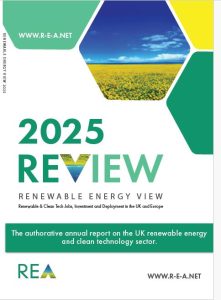
UK renewable energy industry employment now outstrips oil and gas by more than 30,000 jobs
- Renewable energy industry passes 145,000 roles for the first time, with oil and gas jobs declining to just 115,000 in the same period
- Solar PV biggest winner in clean power boom, adding more than 1,000 new jobs in 2024, followed by 800 in offshore wind
- But, the UK continues to lag behind European competitors in per-capita employment due to reduced deployment and lower supply chain investment – around half that of Germany and Denmark
- Analysis from the Renewable Energy Association’s latest REview report, launched today
London, 22 March 2026: Jobs in renewable energy now outstrip those in oil and gas by more than 30,000 roles, according to new data from the Renewable Energy Association (REA).
This initial analysis, launched today in the REA’s annual REview Report, found a record-breaking number of people now work in the UK renewable energy industry, with the employment figure topping 145,000[1] for the first time. By comparison, offshore oil and gas industry employment is falling year on year, dropping to 115,000 over the same period[2].
Further analysis undertaken as part of the REA’s annual assessment of the UK’s renewable energy industry found that there are now more than 56,000 jobs in wind power, 14,000 in solar technologies, and 45,000 in bioenergy. Overall employment numbers in the sector are projected to grow significantly the coming decade, with REA modelling predicting over 265,000 full-time equivalent jobs in renewables by 2035 with continued industry support.
These jobs are evenly distributed across the country, with almost seven in 10 (69%) renewable energy roles found outside of London and the South East. The North East, the area of England with the greatest number of economically deprived neighbourhoods[3], saw the equal biggest jump in renewable energy jobs, demonstrating the role that the clean power sector can have in bolstering struggling local economies. It, alongside the West Midlands, achieved a 2.1% increase in jobs compared to the previous year’s figures. London saw the slowest growth in jobs, with just a 0.9% increase.
The data is released amid a significant surge in oil and gas prices following the outbreak of conflict across the Middle East.[4] With the UK’s energy prices almost always decided by the price of oil and gas these international developments could have a significant knock-on impact on household energy bills, as was seen following Russia’s invasion of Ukraine in 2022.
Trevor Hutchings, Chief Executive of the REA, said:
“Renewables and clean tech have been a huge success story, with clean power providing over half of Britain’s electricity and thousands of high-paying, future proofed jobs. But, despite this momentum, we’re increasingly seeing calls to pull back renewable generation in favour of a return to fossil fuels.
“North Sea fossil fuels continue to play a vital role in helping to power the UK, but it’s clear that our long-term, energy future is in our transition to an energy system powered by renewables. Gas especially will be needed in our energy mix for some while yet, but anyone calling for a full return to fossil fuels at the expense of investment in renewable energy is participating in a dangerous distraction, undermining jobs, energy security and our ability to bring down costs.
“The long-term growth opportunities for the North Sea lie in renewable technologies like offshore wind, clean hydrogen and Carbon Capture and Storage, and the knowledge, infrastructure and workforce of the North Sea oil and gas industry must play a vital role in this transition to our clean energy future.
Solar PV was the biggest generator of new employment opportunities, adding the equivalent of around 1,000 new full-time jobs compared with the previous year’s data, closely followed by offshore wind with 800 additional roles created.
The report also highlights the recent progress in deploying renewables and clean tech – which now account for over half of the country’s power supplies, with increases in biofertiliser production and one in every five new cars sold being electric.
Hutchings continues: “The data is clear. Solar and wind are now the cheapest and quickest way to get new power onto the grid, and bioenergy and other clean technologies are playing a key role in the system to balance variable capacity. Renewables are creating good, skilled jobs the length and breadth of the UK – including in rural areas – and there is considerable potential to create a lot more with the sector now having overtaken jobs in oil and gas in the UK.
“Whether we like it or not, the price we pay for fossil fuels is set by international markets regardless of whether they are extracted from the North Sea or elsewhere. The recent events in the Middle East have thrown into sharp relief the importance of insulating ourselves from price spikes in these markets and ensuring our energy security. The quickest, cheapest and most effective way to do this is with British renewable energy.”
However, there remains more to be done to keep the UK globally competitive. The data found that Britain lags behind its European neighbours in creating job opportunities from renewables. Many of these countries have significantly higher rates of onshore renewables deployment and investment into supply chain production. As a result, Britain’s per capita employment (0.11%) across key sectors – wind, solar PV, anaerobic digestion, and hydro power – is less than half the levels found in countries like Germany (0.26%) and Denmark (0.26%), and significantly below the EU average (0.19%).
Find the full report here: https://www.r-e-a.net/resources/reas-review-25-report-published/
ENDS
About REview
REview 25, is the latest edition of the annual report from the Renewable Energy Association (REA). As the UK’s most authoritative assessments of the renewable energy and clean technology sector, REview 25 provides a clear picture of the progress being made in the energy transition, in terms of renewables deployment, jobs and investment in the sector, in the UK and internationally. This report covers 2024 for data collection purposes (except for certain international comparisons where data is not available for the time period). The report also looks ahead to 2035 and beyond for jobs and sector value forecasts. For the first time, this edition combines select international data, for comparison with the UK’s progress.
Explanatory Note on Timeframes: For data collection and verification reasons, this report covers the following timeframes: 2025 for EVs and EV chargers; 2024 for all other renewables and UK organics statistics; 2023/24 for economic figures.
Jobs figures are based on SIC codes for existing jobs, as reported in National Statistics via ONS.
Jobs forecasting is based on a combination of:
- Historical trend analysis of actual figures with previous forecasts to assess accuracy from the data sources;
- Confirmed planned deployments of renewable energy technologies;
- Planned and speculative deployments of renewable energy technologies;
- Government policies and environmental targets;
- Analysis of future global markets based on environmental targets;
- Technology assessment i.e. solar thermal being partially replaced by heat pump technology.
About the REA
The REA is the UK’s largest trade association for renewable energy and clean technologies with over 400 members operating across heat, transport, power and the circular economy. The REA is a not-for-profit organisation representing 14 sectors, ranging from composting, biogas and renewable transport fuels to solar, storage and electric vehicle charging. Membership ranges from major multinationals to sole traders, giving the organisation a unique perspective on the challenges and opportunities facing the sector. The REA is one of only two UK energy trade associations with official observer status to the UNFCCC, enabling it to provide Blue Zone accreditation at COP30 and to represent UK clean energy on the international stage.
Through our subsidiary company, Renewable Energy Assurance Limited (“the REAL”), we operate 9 market assurance schemes, including the Renewable Energy Consumer Code which works with nearly 6,000 installers of technologies such as heat pumps, solar panels and EV charge points to ensure the highest standards of consumer protection.
For more information, please visit: www.r-e-a.net.
[1] See Table 1 in notes to editors
[2] Robert Gordon University Energy Transition Institute (2025), Striking the Balance: Building a sustainable UK offshore energy workforce
[3] MHCLG, English indices of deprivation 2025: statistical release