

The Renewables & Clean Technology Industry ‘state of the industry’ report, REView25
The state of the UK renewables & clean tech Industry and comparison internationally – Key Facts and Figures from REview 25
Energy Transition Progress
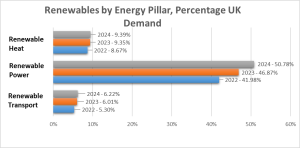
- UK’s Total Energy Consumption from renewables has risen to 2% in 2024 (the most recent full year of data and up from 14% in 2022).
- Renewable energy sources supplied 7% of electricity, 9.4% of heat, and 6.2% of transport demand.
- UK progressing well in renewable power in comparison to some European neighbours, and in EV sales, but lags in heat and transport, catching up would also provide scope to increase job numbers.
Sector Highlights
Power and Flexibility
- 8% of UK electricity is now from renewable sources (up from 47.2% in 2023).
- Wind Power leads the way, contributing almost 30% of renewable power.
- Biomass provides 11% of renewable electricity, as a continuing key source.
Heat and Cooling
- Low-carbon heat meets 4% of heat demand, up from 3.7% in 2013 but almost unchanged from the previous yar.
- Biomass remains the largest source, but growth has slowed.
- Heat Pump installations have grown but still below Government targets.
Circular Bioresources
- There were 105 certified biofertiliser operators in the UK (on, processing 6 million tpa and producing 5 million tpa of biofertiliser (quality and end-of-waste certified digestate).
- Composting sites in England produced over 1.6 million tonnes per annum (tpa) of certified compost Northern Ireland produced 180,000 tpa (9%), Scotland produced 120,000 tpa (6%) and Wales produced 62,000 tpa (3%). Agriculture and soil-grown horticulture accounted for around half or more of certified compost use.
Transport
- Renewables in transport rose to 2%, and 381,000 zero-emissions vehicles (ZEVs) were registered in 2024.
- Over 73,000 EV charge points now available in the UK, a 13,000+ increase from last year.
- Renewable Transport Fuels (RTFs) make up 8% of road fuels used, saving 77% in GHG emissions compared to fossil fuels.
Economic Value and Employment
- The renewable energy sector employed more people in the UK as of 2024 than the oil and gas sector – 145,281 FTEs compared to 115,000 FTEs in Oil and Gas, according to Robert Gordon University analysis on that sector[1].
- The sector is valued at £25.54 billion as of 2023/24, up % from 2022/23.
- Employs 145,281 people across 14 sub-sectors.
- Solar PV leads job growth with around 1,000 extra FTEs with biofuels showing strong growth and offshore wind adding around 800 FTEs.
- Analysis and modelling for the REA shows that the UK could see 300,000 people employed in the sector by 2035, with the right support.
International Comparisons
- The UK has progressed well in terms of renewable power generation, being among the highest globally
- However in heat progress has stalled compared to Europe- while the UK saw a flatlining in growth of renewable heat from 2023 to 2024, at 9.4%, the EU increased renewable heating and cooling by 0.5% to 26.7% of total consumption on average. This is compared to an 11.4% total in 2004.
- The EV sector is growing rapidly worldwide and in 2024, the UK electric car market was the largest in Europe by total sales, with an overall decline in EU sales of Battery Electric Vehicles (BEVs). In 2024 there were 1.3 million new EV Chargepoints installed. China has the highest number installed globally at 3.7 million. The Netherlands had the highest number of publicly available chargers installed in Europe with 180,000 – this is over twice the number the UK had installed, at around 74,000.
- Per capita jobs in selected renewables (solar PV, wind, AD and hydro) is lower per capita (0.11) in the UK than many other countries, such as Germany and Denmark (0.26) and the EU as a whole (0.19). This is due to higher deployment and significant supply chain production in those countries.
- Increasing renewables deployment and securing more supply chains for the UK could therefore increase our employment in this area. Modeling for the REA shows that with the right support the UK could secure 300,000 jobs in renewables and clean tech by 2035.
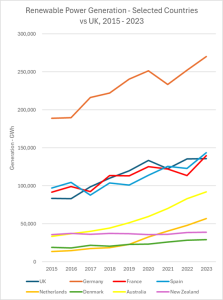
The UK’s renewable sector shows robust growth in some sectors, yet comparison to some other European countries highlights that critical policy changes are needed to meet net zero targets and accelerate the energy transition while capturing the employment opportunities.
[1] Robert Gordon University, Aberdeen, RGU report issues UK offshore energy industry jobs warning | June 2025 | News | RGU
The Renewable Energy and Clean Technology Sector
Renewables and clean technologies such as composting, electric vehicles and energy storage are a significant part of the UK economy and a cornerstone of the modern energy system.

Economic Value
The renewables and clean tech sector employs around 140,000 people, with many jobs outside of the south east (Source: REA, 2024)

According to the CBI, the wider green sector employs almost 1 million people across the UK involved in the green economy transition (Source: CBI, 2025)

Renewables such as wind have been proven in academic research from UCL to have saved UK energy bill payers £104 billion since 2010 due to displacing more expensive, volatile fossil fuels (UCL, 2025)


Energy and Circular Economy Benefits
Renewables provide over half of all the UK’s electricity – 50.4%, as of 2024. (Source: DESNZ Energy Trends, 2025)

Renewables as a whole provide almost 10% of the entire energy demand of the country – across power, heat and transport (Source: DESNZ Energy Trends, 2025)

Renewables have completely replaced coal in the system – with no coal used to generate power since the end of 2024 (Source: DESNZ Energy Trends, 2025)

The industry created around 2 million tonnes of quality composts, from around 4 million tonnes of waste, avoiding this going to landfill (Source: REA, 2024)
Almost 5 million tonnes of quality biofertiliser produced in 2023 – replacing fossil fuel fertilisers (Source: REA, 2024)

There are now over a million EV cars on the roads (Source: SMMT, 2025)

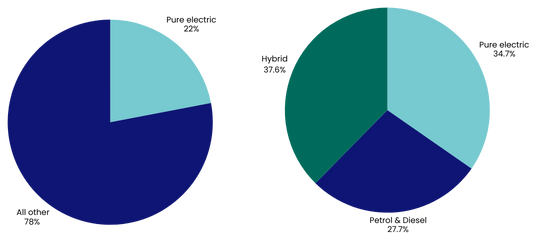
Over 1 in 5 new cars sold are now electric vehicles (22.1% as of September 2025), and when taken with hybrid (which use both batteries and a petrol or diesel engine) car sales, over half of new cars sold are electric or hybrid models (Source: SMMT, 2025)
The renewable fuel content of petrol at the pump has doubled since 2021, at 10%, up from 5% before that date (Source: DfT, 2025)
In Europe, over a quarter of heat used is supplied from renewables – mostly bioenergy and heat pumps, with countries like Sweden showing what is possible, at over 65% renewable heating supplies (Source: IEA, 2025)

The UK has further to go to decarbonise heating supplies but 2% of UK households rely on renewables for either all or part of their heating, and heat pump installs have increased 45% from 2024 to 2025, reaching a record level. Biomass still provides almost half of domestic renewable heating supplies (Source: DESNZ, Ofgem, 2025)

Public Support
80% of the UK public support the use of renewables to provide energy, according to Government statistics, with only 4% against (Source: DESNZ Public Attitudes Tracker, summer 2025)

Overall 79% of the country are concerned about climate change, and 91% of people are aware of Net Zero. More people expect a positive impact from the energy transition in the longer term than a negative one, showing the public value action on renewables (Source: DESNZ Public Attitudes Tracker, summer 2025)