
Geopolitical tensions making UK energy bills more expensive
Author: Matt Parry, Head of Energy Demand and Power
Ministers have already used one lever (cutting VAT from electricity bills) but higher gas prices are pushing bills up regardless, hence another lever needs to be used
With Ofgem announcing a 4% rise in the energy price cap from October, as the closure of the Strait of Hormuz knocks out roughly a fifth of the world’s LNG supply, it is increasingly clear that the government needs to take urgent action on bills to protect households and the broader economy. The increase will lift the typical dual-fuel bill to £1,723 a year, further squeezing consumers already under pressure from the cost-of-living crisis. Ministers will need to act before the next price cap is announced in November. Targeted support for the poorest households will only help at the margin, but it will not stop the damage spreading through the wider economy.
The price cap is the default tariff paid by most UK households for gas and electricity. Ofgem’s 4% increase for October to December, compared with the July-to-September period, is driven largely by gas, which rises by 8%; electricity is up by a more modest 1%, a discrepancy that says more about Britain’s growing renewables share than any headline figure could. The direction of travel is right. The pace is not. Ofgem’s next price cap announcement, due in November, will not (without serious action) reflect it.
A 4% rise in the typical dual-fuel bill, alongside sharp increases already visible in airfares, food, petrol and diesel, will squeeze UK economic growth from two angles. First, higher inflationary pressure will add to the case for higher interest rates, lifting borrowing costs and weighing on economic activity. Second, dearer gas and electricity will leave households with less to spend on other goods and services, directly curbing economic activity. October’s price cap rise deepens the strain on an economy already under pressure; do nothing and January will bring a second blow, as demand picks up when temperatures traditionally plummet.
Ofgem’s decision adds more than £60 to the typical annual dual-fuel bill compared with July (it would have been closer to £100 higher without the six-month removal of VAT from electricity bills already in place). However the Strait of Hormuz situation unfolds, gas prices look set to stay high for week: much of the region’s LNG capacity has been damaged, and European gas storage sits at 63% full, well short of the five-year average of 81%. On current trajectories, the typical dual-fuel bill could rise to around £1,870 a year from January 2027 without additional government intervention. The REA is proposing a relatively simple answer: scrap all remaining levies on household electricity bills, cutting the typical dual-fuel household bill by around £112, or 6%, compared to the scenario in which ministers do not do this. By moving these levies onto general taxation, the Treasury would forgo £3.2 billion over the course of a full year, but the maths suggest it would get most of that back.
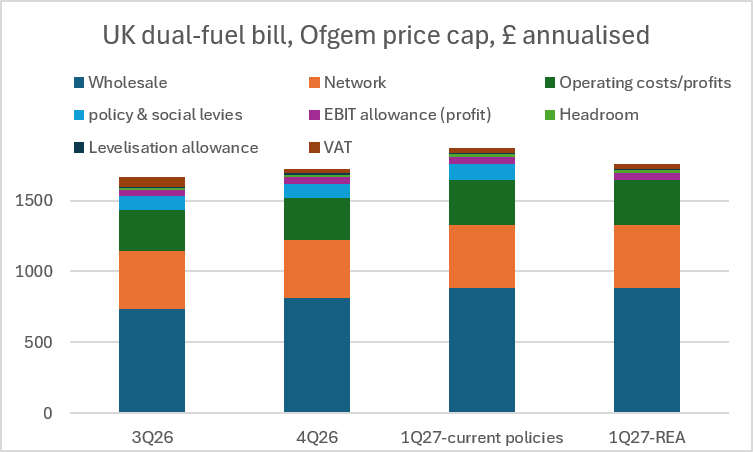
Shifting levies from electricity bills onto general taxation would, in effect, swap a regressive charge for a progressive one. Income tax rises with earnings; electricity bills consume a far larger share of a lower-income household’s budget. Lower relative bills would leave households with more disposable income, lifting consumer spending and, by extension, GDP and tax receipts. The REA estimates the net effect at £3.6 billion of extra annualised economic activity, which (assuming tax buoyancy of 0.99 according to IMF research) should generate a similar amount of additional tax revenue. The £3.2 billion outlay, in short, would more than pay for itself and the government would be spared another politically toxic bill spike. Removing levies from household electricity bills would therefore keep inflation lower and support spending, leaving the Treasury better off.
The broader macroeconomic case reinforces the point. Electricity prices feed directly into the consumer price index. A 6% reduction in household bills, relative to the alternative 1Q27 scenario, would be much less inflationary set against the same quarter a year earlier. Without removing additional levies, the typical 1Q27 dual-fuel bill would be 6.4% higher than 1Q26 – a big inflationary driver – versus flat, if all levies are stripped out, no small feat given the state of the geopolitical backdrop. The last thing the beleaguered UK consumer needs is for the Bank of England to be forced into raising interest rates.
Removing levies from household bills would help with the immediate crisis, but the UK’s structural exposure to fossil-fuel shocks will not disappear until more homes and businesses are permanently weaned off gas. The government’s Warm Homes Plan is a welcome step in the right direction, but even with this support, rooftop solar, batteries and heat pumps remain too expensive for most ordinary UK households.
The biggest prize lies in the tax system. The success of salary sacrifice for EVs shows how quickly a green technology can move from niche to mainstream once it becomes tax efficient. The same trick could work for the home: let households pay for solar panels (including plugin solar), batteries and heat pumps out of gross salary (before income tax is removed), not net salary. That would cut bills, reduce peak demand on the grid and lessen the need for costly network investment, while also shrinking Britain’s dependence on expensive imported gas.
The gains would not stop at the household level. According to the Warm Homes Plan, households that install rooftop solar, heat pumps and batteries can cut their bills by an average £550 a year. Multiplied across millions of homes, that would amount to a meaningful shift in demand, resilience and consumer spending power. This is not simply a case for cheaper bills. It is a case for a system that is cheaper, cleaner and harder for the next fossil-fuel shock to touch.
Collectively the measures outlined here would limit the extent to which bills rise, while putting the UK on a firmer footing for the next fossil-fuel shocks. Neither would require anything like the scale of the £44 billion spent on energy bill support after Russia’s invasion of Ukraine, but they would demand political will. With winter price cap rises now looming, the moment for action is now