
REA Modelling Shows Moving Energy Levies to General Taxation Would Deliver Lasting Relief
Authored by Matt Parry, Head of Power & Energy Demand
Scrapping VAT on electricity bills is welcome, but moving all levies off bills (and onto general taxation) would provide the real ‘breathing space’ that is required
Andy Burnham did not take long to make his mark. One of his first acts (day 2) as Prime Minister was to strip VAT from household electricity bills, a measure that will run for at least six months from October 2026. The REA has pressed for this for years and is accordingly delighted to see it done. Our next request is bolder: take all levies (social and green) off bills too and shift the ‘cost’ (more on this later) onto general taxation. The sums, according to REA modelling, would more than pay for themselves.
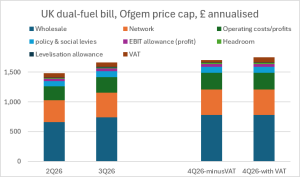
The government reckons the VAT cut will “take around £45 off the yearly Ofgem price cap in October”. That is not, on its own, enough to stop the typical dual-fuel bill rising in the fourth quarter of 2026, compared to the third quarter. Wholesale costs keep climbing, not least because of renewed disruption to shipping through the Strait of Hormuz. But bills would have risen considerably further without the VAT cut. The typical annualised dual-fuel bill is now expected to reach £1,700 in the fourth quarter of 2026, up by about 2% on the third quarter. Without the VAT change, it would have been closer to £1,745, a rise of almost 5% (see chart).
The macroeconomic case is inviting too. The government estimates that removing VAT from electricity bills will trim “CPI inflation by around 0.10 percentage points”, i.e. an expected inflation rate of 3.6% for the fourth quarter becomes 3.5% ceteris paribus. Quite how the VAT cut will be funded is a question the REA will leave for others to debate (whether from the budget of the now-abandoned digital-ID scheme or elsewhere); instead, the REA focuses its attention on the economic upside. Taking a UK economy worth just over £3 trillion in 2025 and an elasticity of GDP to electricity prices of between -0.02 and -0.04 (we’ll conservatively estimate -0.02), the REA calculates that the VAT cut alone would support an annualised £1.6 billion of additional economic activity, largely through higher disposable incomes feeding through into higher consumer spending.
Useful as it is, the VAT cut does not (in our opinion) go far enough. Dual-fuel bills are still on track to rise by 2% in the fourth quarter, compared to the third, as European natural gas prices were up roughly 60% over the month through July 24th. The REA argues that Mr Burnham’s government should go further and remove social and green levies from electricity bills as well, moving them onto general taxation instead. Doing so would cut around £150 off the typical dual-fuel bill relative to where we would be without either intervention, an additional £105 on top of the VAT removal. The fourth quarter bill would then come in £68, or 4%, below the third quarter level: a genuine reduction, rather than merely a smaller increase (as the VAT cut alone will achieve), and the kind of ‘breathing room’ Mr Burnham has promised struggling households. The REA’s modelling suggests this second step would generate a further £3.74 billion of economic activity, on top of the gains from the VAT cut.
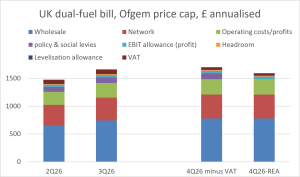
The fiscal arithmetic is where the proposal gets really interesting. Moving levies off electricity bills and onto general taxation would cost the exchequer an estimated £2.99 billion up front, based on 28.6 million UK households (ONS data) each saving £105. But the REA’s modelling suggests the resulting £3.74 billion boost to economic activity would generate about £3.7 billion of extra tax revenue (assuming a tax buoyancy rate of 0.99 according to IMF research). On these numbers, the move more than pays for itself. It would also amount to a small piece of redistribution: swapping a progressive charge, which weighs more heavily on poorer households as a share of spending, for a progressive one that rises with income.
Cutting levies and VAT from electricity prices would ease the immediate squeeze, but over the longer-term more needs to be done to wean homes off gas altogether. The government’s Warm Homes Plan is a step in the right direction, yet rooftop solar, battery storage and heat pumps remain out of reach for most households even with the support on offer. A more powerful lever sits in the payroll system. Salary sacrifice schemes have already shown, with EVs, that making green technology tax efficient can turn a new technology into the mainstream choice once employees could spread the cost through gross pay (i.e. before tax). The same tool applied to domestic energy systems would work similarly well. Households that install rooftop solar, heat pumps and battery storage already save nearly £550 a year on their bills, reduce peak demand on the grid (easing the scale, and cost, of planned network investment – another huge chunk of bills) and cut Britain’s reliance on expensive imported gas. Multiplied across millions of UK homes, the impact would be huge.
Taken together, these measures soften this year’s bill rises while building a more resilient system for the fossil-fuel shocks still to come. Neither strategy requires anything like the £44 billion spent on the previous round of energy-bill support. What both need is political will, and given the current state of the world, this may be as good a moment as any to find it.
About Matt Parry: Matt Parry is Head of Energy Demand and Power at the Renewable Energy Association (REA), where he leads strategic analysis across power markets and the energy transition. He also serves as Secretariat to four of the REA’s flagship member forums: Solar & Storage, Decentralised Energy, Data Centre, and Finance & Insurance. Matt has established and led high-performing analytical teams translating complex dynamics across renewables, power, hydrogen, gas, oil, and carbon markets into actionable intelligence for investors, policymakers, and corporates. His expertise spans quantitative modelling, policy analysis, scenario development, and strategic forecasting, including detailed energy demand outlooks to 2050 across more than 80 countries.